Showing posts with label Littles Learning. Show all posts

8.21.2015

Guest Post Series "The Professionals," Part 2

Hopefully you were able to read my friend Christine's guest post on the blog last week, which kicked off my new guest series dubbed "The Professionals." I'm introducing several of my friends who are all accomplished, creative professionals in their respective fields and have asked them to share advice, parenting tips, how they pursue their professional goals and more in each post. Christine, who is a talented and passionate teacher, is sharing the second half of her post on teaching children literacy. Read on!


6.) Vocabulary: Beginning readers must use the words they hear orally to make sense of the words they see in print. Vocabulary also refers to high frequency sight words, which are the most commonly used words that children are encouraged to memorize as a whole by sight so they can automatically recognize these words in print without having to use any strategies to decode.

· There are two parts to vocabulary: high frequency sight words (words that CANNOT be decoded), and vocabulary words.
· For sight words look up: http://www.wisd.org/users/0001/docs/GVC/WISD%20High%20Frequency%20Word%20Lists%20by%20Grade%20Level.pdf
· This is the list of all high frequency sight words kids should memorize broken down into grades. These are words that cannot be decoded and must simply be memorized.
· To help with memorization of sight words you can: begin by teaching the word to your child, put the words up on a wall so he/she sees them frequently, ask your child to find the word in newspapers, magazines, books, at the store. Play the memory game by putting the words on index cards. Make flash cards of the sight words and time your child to see how many he/she can recite in a minute. If your child can write, have he/she write the words on paper, chalkboards, or dry erase boards.
· For vocabulary words: read, read, read! The more your child hears words in a book, the more familiar he/she will become with vocabulary words.
· Speak to your child in complete sentences and using adult words.
· Give definitions of words your child is not familiar with
· Pick one new vocabulary word a week and study it all week long, put it up on a wall, have your child try and use it in a sentence, or identify when YOU use it in a sentence.

7.) Comprehension: Comprehension is the reason for reading. Good readers think actively as they read. They use their experiences and knowledge of the world, vocabulary, language structure, and reading strategies to make sense of the text.

· Comprehension is the most important part of literacy. A child can be an excellent, fluent reader, decode any word, or know an arsenal of vocabulary words. But if he/she cannot comprehend what they have read or written, the above skills are without value.
· For beginning readers, give your child a picture book and even if he/she can’t read, ask her to “tell you the story” using the pictures. Most children begin by looking at the pictures, flipping the pages and telling the story as they think it goes based on the pictures.
· The most basic steps of comprehension begin with conversation. Ask your child what happened in the book. What happened first, next, and last?
· Who are the characters in the story? Where there any villains? Where did the story take place? What happened?
· Use past experiences to connect the story to your child. Ex. Has this ever happened to you before? Did this remind you of a time when…? Where have you seen this animal before?
· Read a story to your child, then have him/her draw a picture of what happened in the book.
· Ask your child to predict what could happen next in a story. Before turning the page, talk about what they think will happen next. Ex. What do you think will happen next? Can you make a prediction?
· Encourage further comprehension skills by teaching inference. The most basic way is by using the pictures to decipher what has happened in the story, even when the text does not say. Ex. A picture of a boy with tears on his face but the text does not say he is sad or crying. Ask your child: how does the boy feel? (sad, upset, crying). How do you know he is sad? (because he has tears on his face, because he is crying, he looks sad).
· For older students, have them make a comparison and contrast chart (Venn diagram) on two characters in the book, or two different settings, or compare and contrast two different books.

8.) Spelling: the understanding that words are made up of separate speech sounds (phonemes) and that letters represent those sounds.

· Spelling is a combination of writing, phonemic awareness, phonics, and memorization.
· To reinforce spelling, all of the above literacy characteristics must be practiced regularly.
· Play the memory game with spelling words, have your child practice writing out words and use flashcards
· Remind your child to sound out words that can be decoded and memorize sight words.
· Have your child “write” the spelling words in the air with their fingers.

9.) Writing: writing is a complex task that balances purpose, audience, ideas and organization with the mechanics of writing (sentence structure, word choice, spelling).

· The only way to become a good writer is to write constantly. This begins as young as children can begin holding crayons, markers or pencils.
· Writing can be drawing a picture that a child then orally tells a story for.
· At the beginning stages, drawing pictures is a child’s form of writing and their way of communicating stories. Even if the pictures look like scribbles, if a child can orally tell a story and describe what they drew a picture of, this is considered writing (think back to the early days when humans drew pictures on cave walls)
· Have your child practice writing his/her name
· Tracing letters, writing sight words, vocabulary words, or creating sentences with magnetic words
· Use shaving cream or sand and have your child practice writing his/her name, letters, or sight words in the shaving cream and sand
· As they get older and can begin writing sentences, have your child write a daily journal of what they did that day.
· Make them write the grocery list for you, or cards to grandparents and siblings. 


Each child develops differently and as a parent we must evaluate what our child’s strengths and weaknesses and work on what we think they need the most or believe is the most important. Teaching literacy to children can become a part of your everyday routine if you choose to incorporate it into your daily activities. Simply by instilling a love of books and writing to your children will help them realize that reading and writing are fun and hopefully they will carry those beliefs into their years of schooling.

------------------------------

Thank you so much, Christine, for sharing such great information! And hopefully you, the reader, have been able to glean a fresh perspective or some helpful ideas and tips for your own kiddos! I know as mine begin to recognize more and more letters and express a desire to learn how to write or constantly ask what words say that they spot everywhere, I'll be implementing as much of this as possible. Literacy is as literacy does. ;)
post signature

8.10.2015

Introducing My New Guest Post Series, "The Professionals"

When I first met my friend, Christine, 29, we were both scrawny, skinny kids in a big giant pool learning how to do a ballet leg and master moves upside down with our legs in the air that looked graceful and not like we were drowning.

In fact, I can thank synchronized swimming for introducing me to an entire group of lifelong friends that I’ve held close for many years now (you can read about our team's 30 year reunion here!). Christine and I met in 1997 when I was 12 and she was 11. It’s been so special for us to have grown up together and continued our friendship as we parted ways post-synchro to pursue educations, careers and, ultimately, family and children.

christine and her family
When it came time for Christine to begin her college adventure, she chose the University of the Incarnate Word in San Antonio—where our former synchro head coach now oversees the team there—to pursue synchro collegiately in tandem with her degree in psychology. “I followed through with that dream for the first year of college, then decided that it wasn’t for me and pursued other ventures for the remainder of my three years,” says Christine. “Following my college graduation in 2009 (magna cum laude), I was accepted into the New York City Teaching Fellows and immediately moved to New York City to follow my two passions: becoming a teacher, and my then-boyfriend of six years.”

Out of 700 applicants accepted into the NYCTF program, Christine was one of only 24 that were bilingual and was placed in a bilingual special education program. For the next two years, she taught full-time while simultaneously earning her Masters of Science in Bilingual Special Education, where she graduated suma cum laude from the City College of New York in 2011.


Christine married her highschool sweetheart, Juan, four years ago and they now have an adorable little boy and live in Chicago. She currently substitute teaches when she’s not busy toting around little Juan Jr. or working on combining her love of education with that of nutrition as she is also an independent educator for the New York-based biz, Veggiecation. “It’s a culinary, nutrition, education program that teaches kids the importance of eating their vegetables in a fun, engaging, and interactive way,” she explains. “In the fall, I will begin working with schools and teaching kids of all ages the importance of eating their vegetables and creating new and exciting recipes with them that they can taste.”

But being a mother has and will always be the highlight of her life. “Having a child of my own has been the greatest joy I could ever as for, both as a parent and educator,” says Christine. “It has been fascinating for me to see the different developmental milestones and how he has approached them and watch his personality and curiosity for the world develop.”


When I asked Christine if she’d be interested in guest posting on my blog about education, she couldn’t have said yes more quickly! This is a very passionate topic—and lifelong endeavor—for Christine and I’m thrilled to share her story with you as well as her tips and information on teaching literacy to children. This will be a two-part post, so don’t miss it!
My Passion for Education and Teaching Children Literacy
By Christine Muldoon

My first teaching job was at PS146 in East Harlem. I was originally hired as a Bilingual Special Education teacher and aside from teaching in a class room, my job was to work with another bilingual educator (another teaching fellow in my small group of bilingual educators) to develop the transitional bilingual program at PS146.
At the time we had no idea what that meant and neither did our principal, so we flew by the seat of our pants the first year and tried our best to create a functional program, interact and translate with Spanish-speaking parents (70% of the school population was Hispanic and only three teachers spoke Spanish fluently). And, of course, be the best teachers we could be to a group of disadvantaged kids in East Harlem.

My first year I taught Kindergarten, followed by teaching first grade for the next three years. I was in a co-teaching classroom for three years as well—which means there are two teachers in a classroom. One is a general education teacher, and the other a special education teacher. Legally, in a co-teaching classroom, 60% of the students are general education and 40% special education, and the classroom caps at 28 students. Unfortunately, in a D-rated school in East Harlem, this is hardly the case and many general education students should be special education and vice versa.

In my fourth year of teaching I was moved to a self-contained classroom. There are 12 special education students, one special education teacher, and one to three para-professionals. For my fifth year I switched to a private school, also in East Harlem, and a school just for special education students where I taught 1st grade again. Currently I am substitute teaching for two private schools in Chicago, and I work with mostly pre-K through 2nd grade.

There are many different theories on how to teach literacy and each school or daycare uses a different curriculum or method. It is very easy to get swept up in the waves of information the Internet can provide. I do not consider myself a literacy expert by any means; however, I have six years of teaching experience, four in a New York City public school and two in private schools. I’ll offer my point of view and hope you find it useful.

I believe that although some methods differ, there are many basic steps parents can take to adequately prepare their little ones for school and get them started on a successful path to literacy. In order to fully understand the purpose behind these educational activities, it is important to comprehend the building blocks to literacy.

Literacy begins at a young age, it can even begin as early as infancy. The concept of literacy looks different at each developmental stage of a child and differs from child to child. The following are a few basic characteristics of literacy:

1. Print Awareness: this is the understanding that the squiggly lines on a page represent spoken language.

2. Sounds of Speech: In order to understand a spoken language, a child must be able to hear the sounds and words that make up the language.

3. Phonemic Awareness: the ability to hear, identify, and manipulate individual sounds (phonemes) into spoken words. Before a child can read print, he/she must know how the sounds in words work.

4. Fluency: the ability to read a text quickly, accurately, and with expression. Fluency is the key to connecting word recognition with comprehension.

5. Phonics: the idea that letters and letter patterns represent the sounds of spoken language

6. Vocabulary: Beginning readers must use the words they hear orally to make sense of the words they see in print. Vocabulary also refers to high frequency sight words, which are the most commonly used words that children are encouraged to memorize as a whole by sight so they can automatically recognize these words in print without having to use any strategies to decode.

7. Comprehension: Comprehension is the reason for reading. Good readers think actively as they read. They use their experiences and knowledge of the world, vocabulary, language structure, and reading strategies to make sense of the text.

8. Spelling: the understanding that words are made up of separate speech sounds (phonemes) and that letters represent those sounds.

9. Writing: writing is a complex task that balances purpose, audience, ideas and organization with the mechanics of writing (sentence structure, word choice, spelling).


Now, as parents, how can we apply these characteristics in a practical manner on a daily basis? For many of these characteristics, the application can be as simple as conversations with your little one (no matter how young) or reinforcement of activities you probably already do during the day. Below are a few examples of how you can apply the literacy characteristics on a daily basis and what it would look like.

1. Print Awareness: this is the understanding that the squiggly lines on a page represent spoken language.

  • pointing to the words on a page as you read to your child
  • asking your child where are the pictures, where are the words on a page
  • asking your child where is the title of the book
  • having your child point to (or show your child) words in a magazine, newspaper, signs at the grocery store, signs on doors, etc.

2. Sounds of Speech: In order to understand a spoken language, a child must be able to hear the sounds and words that make up the language.

  • modeling appropriate conversation for your child, speaking in full sentences (even to babies)
  • peaking with intonation, expression, and using adult words; even if you think your child will not understand them, they are getting exposure to those words at an early age.

*Most teachers would agree that phonemic awareness is extremely important in regards to literacy. Most kids will come into Kindergarten knowing their letters but not knowing that letters make sounds and the sounds are what we use to create words.

3. Phonemic Awareness: the ability to hear, indentify, and manipulate, individual sounds (phonemes) into spoken words. Before a child can read print, he/she must know how the sounds in words work.

  • teach your child that a letter has a name AND a sound. ie: “Yes, that is the letter “T” it makes the /t/ sound.
  • ask your child what SOUND do the letters make
  • model the correct way to sound out the letters. ie: the letter P makes the /p/ sound, not /pu/
  • look for other objects that begin with the same sound as the letter you are studying. ie: “What else starts with the ‘s’ sound? Snake, soup, sad, etc
  • for older students have them underline, color, or circle words that begin with the same letter sound
  • start with your child’s name. ie: Harrison starts with the “h” sound, what else starts with that sound?
  • begin teaching sounds with basic consonants and short vowel soundsthe first. Most kids don’t move onto diagraphs, blends, or long vowel sounds until the end of 1st grade

4. Fluency: the ability to read a text quickly, accurately, and with expression. Fluency is the key to connecting word recognition with comprehension.

  • once a child is beginning to read, fluency is taught by encouraging the child to use his/her finger to follow the words as they read. This is called: tracking
  • as a child becomes a better reader, the finger is removed and the child is taught to track the words with his/her eyes.
  • you can model fluency by tracking the words as you read to your child. Fluency also includes reading with expression and intonation. ie: use expression when reading a sentence that ends with an exclamation mark or question mark.
  • for young readers you can use popsicle sticks as a “pointer”
  • if you have access to a big book, use a pointer stick and have the child come up to the book and point as you read.

5. Phonics: the idea that letters and letter patterns represent the sounds of spoken language

  • the goal of phonics is to teach kids to decode words (sound words out, or blend sounds together to read a word).
  • similar to phonemic awareness, ask your child to identify the sounds the letters make in simple words such as: cat, hat, pat, etc.
  • use Dr. Seuss books to begin teaching sounding out words
  • use fingers to “tap out” sounds in words. ie: when sounding out the word “cat” hold together thumb and forefinger and clearly say the sound /c/, then hold together thumb and middle finger and say the sound /a/, then hold together thumb and ring finger and say the sound /t/. c-a-t. This is a full sensory (visual, auditory, kinesthetic) approach because it helps kids break words down into each individual sound using their hands (kinesthetic), saying the sounds (auditory), seeing the separation of sounds with the tapping of each finger (visual).
  • for more information on “tapping” words you can go to www.fundations.com It is an entire literacy curriculum based on decoding words using the tapping method.

-----stay tuned for part 2!

I hope you enjoyed this post and thanks to Christine for sharing such insightful information and tips! I'll be back soon with part two, the completion of this post, and also have a few other guest posts lined up for my "The Professionals" series that I hope to continue into this fall!

Thanks for reading :)
post signature

6.24.2015

Noah's Ark Lesson + Animal Craft

It's been awhile since I've done a book and craft combo with the kids, so when I spotted a box craft set of paper plate animals on super sale at Michael's I went ahead and grabbed it to stow away for a rainy day. A few weeks later, I came up with an animal-related lesson we could do and found a Noah's Ark book
while at the library.


After a massive toy swap out in their play room, I remembered we actually had a Noah's Ark toy in their box of Little People stuff so I pulled that out and used it to explain who Noah was and what the ark looked like. The kids each held two animals of their choosing while I read the book to them, then I slid the boat around the table and let them each march their figurines into the ark "two by two" before we started our craft.


I'm not one to shy away from putting together a set of craft supplies myself—and I keep several craft drawers stocked with random supplies to rummage through for just such an occasion—but it really did help that everything I needed came in the box.  The quads were able to peel the paper backing off the foam sticker pieces themselves and I would show them how to copy the photo on the box to assemble their respective animals. Coincidentally, two made a zebra and two made a monkey.


They were quite proud of their finished pieces and show them off to anyone who comes over since I hung them on their art boards in the play room (along with their super cute Father's Day card my mom helped them make, complete with flowers!).


After the craft, we watched our Baby Einstein's Baby Noah DVD—yes, we still have many of our Baby Einstein DVDs because they still love them—and it held their attention for the entire 38 minutes. That's like five years in toddler time, right!? I actually emptied the dishwasher and reloaded it, completely uninterrupted and without up to eight hands wanting to "help me." Plus, I think between the craft, Little People toy and DVD, the concept of Noah and his ark was very much solidified in their minds because they've repeated the story a few times since.

Mission accomplished.
post signature

1.26.2015

Weekend Recap (Plus a Cookie Book + Craft!)

Weekends don't typically include Thursdays, but I'm tossing in a couple photos from our Thursday evening because it involved a play date with our fellow quad squad besties at their house and the husband got to come along! He'd been out of town for work so not only was I all too happy to see his face at long last, but also for him to get to join us and see the kids at play with their buddies. It was a wonderful evening and Amber (my quad momma BFF, and yes we even share the same name!) made such a delicious pot roast for dinner and all eight two-year-olds played their little hearts out.


On Friday morning, I was planning to take the kids somewhere but hadn't finalized my plans yet when the husband called. It was a chili cook-off at his office for lunch and he was game to have some pint-sized visitors, so we loaded up and headed off to join them! The kids were so well-behaved and enjoyed lunch. The husband's chili came in second! (I may have helped.) And the entire office got a kick out of Harrison when he managed to conference call everyone's phones and share a couple words with them all. Haha.


On the way home, I started feeling pretty bad. All last week I had a terrible sinus infection and it was just starting to get better when I came down with some pretty bad nausea, throbbing neck and shoulder pain and an awful headache. It stayed that way for nearly two days. :(

We had pizza for dinner since I didn't feel up for cooking, but I did manage to do a book + craft combo with the quads and thankfully the husband was home in time to help. They loved the book and they loved decorating their cardboard "cookies" even more! I cut own frosting-shaped pieces of sticker foam then gave them colorful foam sticker shapes to use as sprinkles. We discussed shapes and colors throughout the entire project and they got a kick out of putting their finished cookies on the wire rack I set out.


Saturday didn't amount to much since I was still feeling badly and the husband picked up most of the slack for me so I could rest. I think stress from the past week may have contributed to me feeling sick, I hate that terrible ache you get in the back of your skull and neck sometimes that literally hurts so much it makes you sick. Ugh!

Sunday was a definite improvement and we got everyone ready and made it to church. The quads just love going to church, they attend children's church while we're in the service, and then we go back on Mondays for school (Mother's Day Out). I also just registered them for summer camp, which will be Tuesdays and Thursdays from 9am to 2:15pm, as well as pre-school for the fall!!! Can you believe it!?! By the fall, my babies will be three years old (and potty trained, that's happening soon!) and attending pre-school two days per week. I just can't believe we've come so far...


They attracted several admiring onlookers at church while they sat patiently and waited for daddy to go get the car. They are all four so sweet and well-mannered most of the time, especially when we're out of the house. Nearly every time I pick them up from school, their teachers are telling me how polite they are. Music to my ears!

We headed straight to a fried lunch at Chicken Express then home in time for naps. My mom swung by and picked up Kailey and Logan to take to her house for the afternoon, so while Harrison and Trystan chose to sleep in their absent sibling's beds, I snoozed on the couch downstairs. 


After we woke up, I took my two munchkins to a local bounce house for some jumpy fun. They were so sweet together—Harrison would wait for Trystan so he could "help" her climb up the steps to the top of the slide. Then he would slide down first so she could see how to do it and she would follow him. They had a blast and I have to say that two kids is a piece of cake for me!


Now I'm back to four kids, which I dropped off at school this morning, and I'm hitting the ground running with a long to-do list to knock out while they're there. It's a busy week, but will hopefully be a productive one, especially since I'm starting to feel better. I'm still working on cleaning up and organizing my house for 2015, and the downstairs is getting hit today! Stray toys are not barefoot friendly....
post signature

12.15.2014

Nativity Toddler Book & Craft

As the Christmas season gets in full swing, I've been keen on teaching the quads about Baby Jesus and His birth, the manger and the nativity scene. Though they might not fully grasp the concept of Jesus and what His birth signifies, they can certainly learn that He's a special person and that we celebrate him always, especially at Christmas. Here's a quick book and craft combo I put together for an afternoon at home! They really enjoyed it.


I printed this coloring page of Baby Jesus in a manger, then while the kids put their crayons to paper I cut up some raffia I had in my craft closet and pulled out a package of colored craft sticks I got at Wal-Mart.


Then we read one of our books before gluing on the craft sticks in each kid's chosen color and then spotting on glue and adding raffia as the hay in the manger.


Afterward, we set the papers aside to dry and read the remaining two books to help solidify the concept. They really listened intently and now readily identify Jesus in the manager in photos, tree ornaments and more. Plus their time at church reinforces these Biblical learnings. Mission accomplished!

How do you share Jesus with your tots?
post signature

9.23.2014

{Littles Learning} Red Week

Earlier this summer, I vowed to begin adding more structure into each week with the quad squad. They are growing and picking up so much so fast these days that I really want to take advantage of their curious, inquiring, impressionable minds and pack them with as much learning as I can. I'm no teacher but I was homeschooled until I was 15 years old then attended a junior college and earned my associates degree when I was 18. Two years later, I graduated from Texas State University with a journalism degree. Considering I pretty much have an instant classroom and value education, I'm determined to do my best with the kiddos until they head off to kindergarten. (We won't be doing preschool since it's a hefty investment times four, though we're contemplating a day or two of mother's day out per week starting in the spring.)

Anywho, I've shared a few book-and-craft related projects under my new Littles Learning category and now I'm sharing the color series we did, in which we worked through each hue of the rainbow, spending one week on each color. 

Here's what we did for Red Week! And keep in mind these activities all took place on various days during the week...


*We started off with a simple activity using threaded beads and red pipe cleaners.


*I had everyone tear up red construction paper, which they loved demolishing.


*Then we added the torn paper to boxes filled with red tissue paper, filler paper and random red objects I gathered from their toy bins.


*We also did painting with various colors using Melissa & Doug paint brushes and cut up sponges (art smocks are from Ikea). We discussed all the different colors and practiced identifying red many times.


*The red piper cleaners made a second appearance inside empty Voss water bottles, and the kids were able to practice twisting off the lids and emptying and reinserting the pipe cleaners into the bottles. Sounds simple enough but kept them occupied on and off that afternoon!


*Lastly, we did a red discovery bin for the whole group with random red-hued items from their play room as well as a few red-covered books. 


*We also read several books on colors and general and practiced identifying all the colors throughout, and took a bath with red bath coloring one evening and only red bath toys (the foam letters and shapes are great for that). 

Stay tuned for more Color Series posts!
post signature

8.26.2014

{Littles Learning} Wheels on the Bus Book & Craft

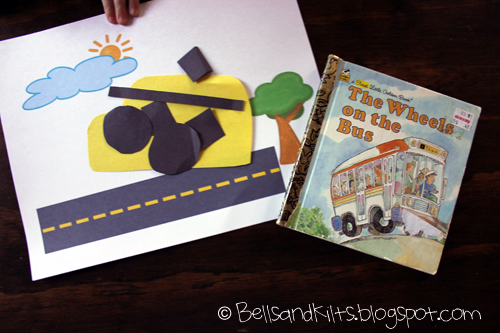
This was my second book & craft combo I tackled with the quads and it was pretty straight forward and easy to accomplish. They love The Wheels on the Bus song so I figured we'd use the book—in which the text is the same as the song, anyway—an easy construction paper craft and anything else I could come up with. That turned out to be toy buys and a few yellow bus kid-friendly YouTube vidoes.


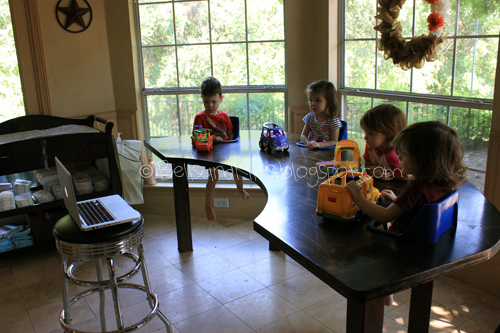
We started off with a couple videos online that had to do with buses, a few were animated and focused on colors or counting, which was a plus. Then we talked about the buses (or cars makeshift buses!) that each kiddo had and their color, their different parts, what they do and so on.


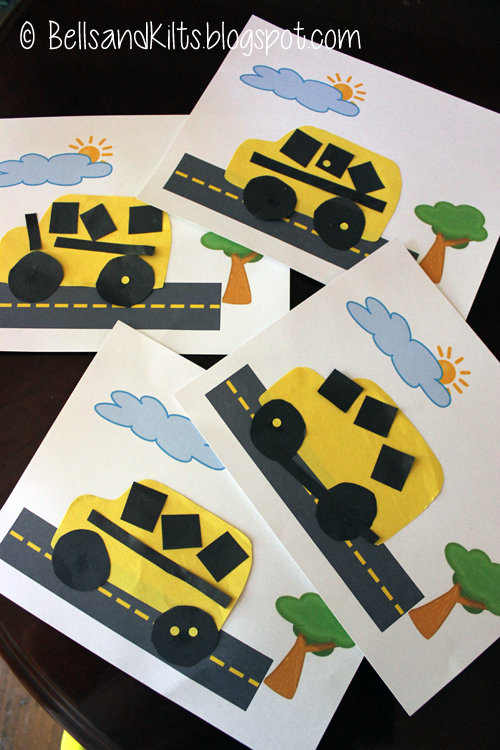
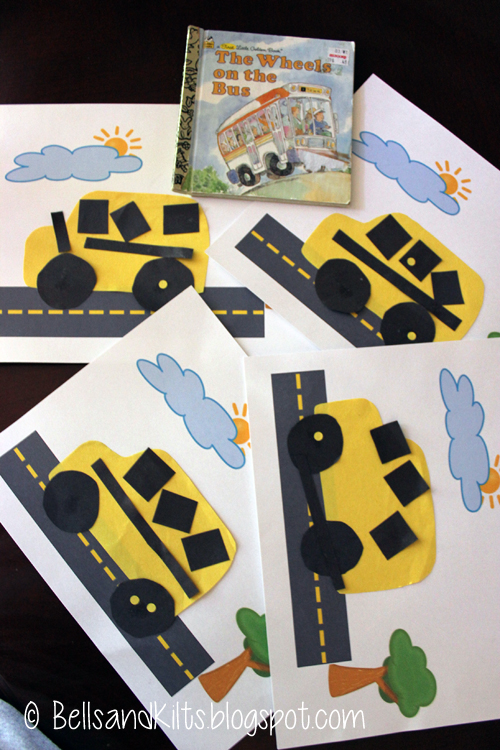
Afterward, I read the book then handed out craft supply pieces. I pre-printed four cardstock papers with a road, tree and cloud clipart I found free online, which seemed to help greatly since the quads acted like they knew just where to put the bus—on the road!


Some frantic glue stick-ing on my part and a little assistance in positing some of the pieces and we ended up with four fully-assembled yellow bus crafts! (I just freehanded the shapes I cut out from regular construction paper.)


Told ya it was easy! 

What book and craft combos do you love or plan to try?
post signature
Related Posts Plugin for WordPress, Blogger...